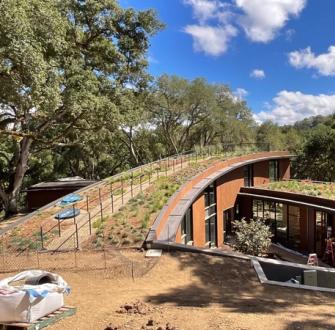
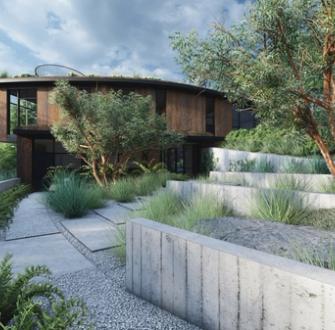
Our ambition extends beyond minimizing harm. We strive to support regenerative environments, empower healthy communities, and contribute to a better future.


Our Approach
We believe truly sustainable, regenerative design begins at a project’s inception and continues on after its completion.
Our comprehensive approach to regenerative design takes a holistic vision of each project’s lifecycle. From operational and embodied carbon reduction and resource management and efficiency, to environmental stewardship and occupant health and wellness, sustainability is baked into our design process. Templates for site analysis and goal setting, checklists for each design phase, and check-ins at project milestones ingrain sustainable design into our office culture, not solely on a project-by-project basis. Each project team establishes & targets a set of stretch goals that advance the greater vision.


Our Leadership
The leaders of our Sustainability Department offer a wealth of knowledge in crafting regenerative, site-sensitive design, master planning, and deep research into the latest in materiality and building science + systems.

Our History
In 2003, our first project, House Ocho set the tone for our work with a site sensitive, sustainable design, winning an AIASF Sustainability Award and a Green Roof Award. In 2010, we designed our first electric, Net-Zero Energy Home, The Santa Cruz Haus, which earned LEED Platinum certification. With subsequent projects like Caterpillar House, the first LEED Platinum Custom Home on California’s Central Coast, and The Farm, a sustainable urban home with grey and black water filtrations systems, we have continuously refined our goals and raised expectations for performance and efficiency. Since our studio’s inception, our acute focus on sustainability has attracted a team of like-minded architects and consultants, as well as clients & collaborators who are passionate about regenerative design and environmental stewardship.
We’re proud of how far we’ve come. Today, our innovative office-wide carbon budget for residential projects tracks and measures each home’s predicted embodied and operational carbon emissions from design through post-occupancy. As signatories of the AIA 2030 Commitment, our studio is working towards a carbon neutral future. Using advanced software like Tally and Climate Studio, we’re able to perform in-depth site analyses, daylight studies, and lighting intensity models to inform our design process.

2030 Commitment
The American Institute of Architects (AIA) launched the 2030 Commitment in 2009, with the goal of achieving carbon-neutral buildings by the year 2030. This means not only achieving net-zero energy but also eliminating the use of fossil fuels. Architecture 2030 has set reduction targets based on a 2003 CBECS baseline to serve as a measuring tool for progress, with the target energy use reducing every five years.
Feldman Architecture made the pledge in 2016 and, as a means to track and document progress towards reduction goals, began reporting performance data to the AIA ‘s online database, the Design Data Exchange (DDX). The reporting process revealed that the majority of our projects, most aiming only to meet the requirements of California’s strict Energy Code, were in the 40%-50% reduction range.
Since our commitment in 2016, we have greatly improved our systems, technology, and processes towards a carbon free future.
Our Progress
Upon the recent release of the 2023 The AIA By the Numbers report detailing the impact of the AIA 2030 Commitment, FA was one of the 31 signatories nationally who reported 80% pEUI reduction target across their entire portfolio.
In 2024, our project portfolio reported a 93.82% average EUI reduction, which, when measured against our 80% reduction goal for 2023, far exceeded our goal. 10 out of 13 of our current projects are predicted to meet our 2030 commitment as they are designed. We’re happy to report that we’ve met the 2030 goal for the 3rd consecutive year.

AIA Materials Pledge
Materials selection is one of the most impactful ways architects and designers can shift to a holistic practice, considering five key aspects—human health, social health & equity, ecosystem health, climate
We source local, low-impact, non-toxic, durable materials, furnishings, and finishes, with minimal chemical treatments and advocate for greater ingredient transparency from manufacturers.
After signing the AIA Materials Pledge, we’re excited to become leaders in the space, and report our company’s progress to AIA toward meeting the goals of all five impact areas of the A&D Materials Pledge.


The Carbon Budget
Human-induced climate change is one of the greatest challenges facing our planet, and we believe that architecture has a crucial role to play in addressing this crisis. The built environment is a significant contributor to greenhouse gas emissions, and it’s our responsibility to take action to reduce the carbon footprint of our work.
To this end, we were very proud to introduce a Carbon Budget initiative for residential projects. Launched in Spring 2023, this initiative took aim at each project’s operational and embodied carbon - we initially set an aggressive target of 100 metric-tons (tonnes) per home (for reference, driving from San Francisco to Atlanta emits 1 metric ton of carbon, and the average FA home has a carbon footprint of ~200 metric tons).
Over the last three years, we've applied our Carbon Budget initiative to more than 15 residential projects, and integrated more accurate and efficient tools and systems that have greatly improved our practice. We're excited to continually educate and fine-tune our process to more accurately predict our project's both operational and embodied carbon emissions earlier in design, and hold ourselves, and our consultants accountable to our vision.
The Carbon Dashboard
Our Carbon Dashboard tracks each project’s predicted carbon emissions from the design phase through one-year post-occupancy, and continues to account for emissions over a 10-year period. Emissions are broken down into two categories – operational carbon, which refers to the emissions produced by a building during day-to-day operations, such as heating & cooling, lighting, and appliance use; and embodied carbon, which refers to the emissions produced during the extraction, manufacturing, and transportation of building components and materials, and the construction process itself. The dashboard quantifies these predicted emissions, also accounting for the renewable energy or carbon offsets required to meet the project's goals.

Carbon Emissions by Project
We track each project’s total embodied and operational carbon emissions as they are designed. The case studies below were selected to illustrate a range of current work from smallest to largest residential projects. The darker orange circle represents the project’s embodied carbon, and the light orange illustrates the operational carbon. ASC, for example, shows 100% embodied carbon and is net-zero, so there is no operational energy associated with the project. The carbon footprint per square foot allows for a direct comparison between projects. For a deeper dive, read our full Carbon Budget case study about Fog’s Edge, or Flow and Stone’s Throw.


A Resilient Future
We can no longer rely on past climatic data to inform our decisions: rather, we must design with foresight to ensure a resilient and sustainable future. Preparing for future natural disasters is urgent and requires a fundamental shift in thinking about the ways in which we build, especially given the fragility of our critical services and infrastructure.
Although no one design can be immune to all risks, we can integrate preventative solutions into our built environment. We must take our cues from the site and its surrounding landscape and use fire-resistant and non-toxic materials that are found naturally and locally, in particular those inherently most resilient to the specific threats faced in the region.
We tap proven and innovative technologies to incorporate structural and mechanical building components and systems that mitigate risks to life and property, in particular those that promote the integrity of the buildings as a whole.
Our designs utilize resiliency strategies like on-site power generation + storage, fire resistant construction, on site water collection, graywater + blackwater systems, and tight building envelopes.