Talking Shop: Making the Case for Craft
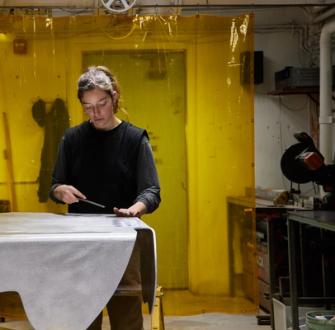
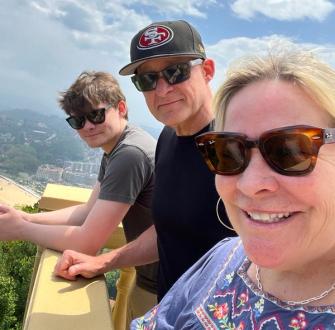
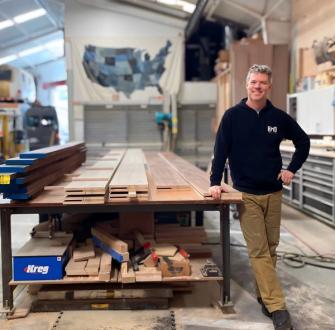
We spoke with Jeff Wheeler, Senior Technical Architect, Ivan Leon Ramirez, and Nate Ingebritson, Designers, about our studio's workshop - lovingly referred to as "the shop" - tracing its origins, its role in the firm’s design process today, and how it may continue to evolve in the future.
Tucked beneath the office, the shop didn’t begin as a fully realized extension of our design process. It started, as many good projects do, with a question: what could this space become?
When Feldman Architecture first took over our current building, the basement was little more than a 1,000-square-foot storage area - underutilized, cluttered, and easy to overlook. In early conversations about its future, Jeff Wheeler, Senior Technical Architect, saw something different. With a door to the outside and enough separation to manage noise, the space had the right bones for a workshop, something hands-on within an otherwise digitally leaning practice.
Working alongside ongoing building renovations, Jeff began to shape the space, adding a partition wall that accommodated tenant storage and defined the shop’s footprint. In the early months of the COVID-19 pandemic, when the office was largely empty, the project quietly picked up momentum. Jeff spent that time clearing, building, and repurposing. He assembled work surfaces with materials from unused furniture, installed shelving, and organized tools. Much of it was done with what was already available - coming together with very little cost, but a lot of intention.
From the beginning, the idea wasn’t just to have a place to build presentation models, it was to create a space that expanded how we think about design. With our digital toolkit well established, the shop offers another way to make physical, analog exploration more accessible to FA's staff of architects and designers.
Jeff, Ivan, and Nate all agree: there’s a clarity that comes from holding a model in your hands. Clients respond to it immediately - the scale, the weight, the ability to understand space without explanation. “Models are a universal language,” Nate says. Early models produced in the shop reinforced that instinct. In one case, a client shared that a model had become one of their family’s prized possessions, kept prominently in their home long after it was presented to them. Jeff sees that kind of response as the goal: models becoming more than presentation tools, but objects people connected with. It’s the sort of reaction that makes every hour spent building them feel worthwhile, something a rendering or image often struggles to achieve.
For Jeff, that connection to making extends well beyond the office. Over the years, he’s taken on countless projects at home, including renovations, furniture, and small experiments that evolve over weekends. As he puts it, “My house is evidence of 24 years of weekends,” and that work feeds directly into how he designs. There’s a constant back-and-forth: details, materials, and construction strategies tested in the studio find their way into his house, while hands-on problem solving at home sharpens how he approaches projects at work. The scale and finish may differ (scrappier at home, more refined in practice) but the thinking is the same. It’s all part of a continuous process of learning by doing.
As the shop took shape, its capabilities expanded. What began as a largely manual space gradually incorporated digital fabrication - the addition of a laser cutter and 3D printer opened up new ways of working. These machines introduced a higher level of precision, speed, and the ability to test ideas in hybrid ways. Ivan Leon Ramirez, Designer, has been central to that evolution. When he first encountered the space as an intern, it was still more storage than shop. When he returned full time, the tools were there, but the systems around them were still taking shape. Ivan spent time learning the machines, troubleshooting issues, and building out clear workflows to create a streamlined set of office standards and processes. It meant a lot of trial and error, digging through manuals and forums, and figuring things out without a clear roadmap. Today, the shop runs smoothly, and Ivan remains a key resource for keeping it that way. He maintains equipment, refines processes, and helps others get comfortable using the tools.


The work happening in the shop has also started to shift. While presentation models are still an important part of how we communicate design, there’s growing interest in using models earlier in the process. For Nate Ingebritson, Designer, this is where the shop has the most untapped potential. Instead of waiting until a design is fully resolved, process models offer a way to think through ideas in real time. They’re quick, flexible, intentionally unrefined, and decidedly not precious. You can, and should, cut apart, adjust, and rebuild them as the design evolves. In a few hours, a team can move from concept to something tangible, testing massing, spatial relationships, and how a building meets the ground.
For Nate, the value of process models extends beyond representation - they actively shape the way a project is understood and resolved. Building something physically, even at a rough scale, introduces questions that can be easy to overlook in digital space: how materials come together, how inside and outside conditions transition, or how a structure might actually be assembled. In that sense, model making becomes less about presentation and more about problem solving. Constructability issues reveal themselves earlier, while ideas are still flexible enough to adjust. The process can lead to a clearer understanding of the design long before those challenges emerge later in documentation or construction, reinforcing the idea that making is not separate from design, but an essential part of it.
Still, integrating process models more fully into the workflow is an ongoing effort. The challenge isn’t whether people know how to build models, but rather shifting when and why they use them. It means moving model making earlier in the timeline, and seeing it not as an extra step, but as part of the design itself. It also means rethinking how time is spent, and making space for a different kind of exploration.


Across the office, the shop supports a range of uses. Interns continue to build models, gaining hands-on experience with materials and tools. Project teams develop sample boards and presentation pieces. The space has also been used for full-scale problem solving, such as fabricating elements for the recent office expansion, installations, and ongoing improvements.
Looking ahead, Jeff’s interested in pushing the shop even further. He sees potential in the shop as a place for fabrication, where certain elements of a project might be designed and built in-house. It could be something small, like a custom detail, or something more substantial, like furniture. The scale may vary, but the idea is consistent: bringing making more directly into the work. He also notes the idea of embedding small crafted moments into projects, distinctive details or subtle “easter eggs” that create a lasting connection between the maker and the building - like the way Frank Lloyd Wright embedded his signature red tile into many of his homes.
Underlying that ambition is a broader belief that people are increasingly drawn to things that feel crafted, specific, and personal. As Jeff sees it, there’s a growing desire for work that is bespoke rather than generic, a return to materials, assembly, and the evidence of the human hand. In many ways, that sensibility already aligns with the kind of custom residential work our practice has long pursued; the shop simply creates another way to explore and express it.
The shop is a valuable space in our studio where hands-on craft is celebrated and experimentation and iteration are encouraged. What started as an overlooked basement has become something much more: a place where materials and assemblies are tested, ideas are refined through process and model-making, and meaningful work takes a physical shape.