Craft: Seema Krish Textiles and Wall Coverings
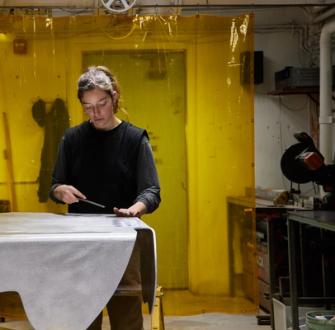
We had the pleasure of welcoming Seema Krish to our office, where she shared her journey into textile design and the inspiration behind her beautiful work. Based in San Francisco, Seema is a designer and craftsperson making handmade interior textiles and wall coverings that draw deeply from her Indian heritage. Her work is heavily informed by the many cities she has lived in across the world, from Bombay to Boston. Sustainability is a central value at her studio, where they use natural fiber cloths and non-toxic, organic dyes. Her work has been featured in Interior Design Magazine, San Francisco Magazine, House Beautiful, Veranda, and more. Seema holds a BFA in Textile/Surface Design from the Fashion Institute of Technology in New York.
How did you end up in the textile design space and what continues to inspire you to create in this medium?
I’ve been interested in drawing and art from a young age. From my first exposure to fiber and textiles in design school, I was hooked!
My career has spanned various aspects of the industry, always with a focus on textiles for interiors. I began my professional journey with the innovative Japanese company, Nuno, which opened my mind to the expansive possibilities of the medium. Driven by a curiosity about my Indian textile heritage, I eventually moved back to India to engage with diverse craft communities. During those years, I worked with the Indian government on craft revival projects, ran a weaving studio focused on innovation and experimentation, consulted for textile mills in Bangalore, and continued to produce textiles for Nuno.
After this period, I returned to the U.S. and was a Design Director for Robert Allen in Boston. While this role immersed me in the business of luxury textiles, I found myself missing the tactile, handmade, craft aspect of textiles. This desire to return to my roots ultimately led me to start my own company. It is this artisanship and the dimensional possibilities that continues to inspire me to work in this medium.
What was your formal training at FIT in New York like? How did your schooling inform your work?
FIT is well-regarded for its industry-focused curriculum, and I was initially drawn to the school by its NYC location and the immense exposure the school and the city offers, from its many museums to diverse internship opportunities.
During my time there, I was fortunate to connect deeply with my weaving professor, who supported me in pursuing design and weave-focused learning beyond the standard curriculum. I clocked many hours in the weaving studios! Additionally, the school frequently hosted prominent industry professionals for guest lectures and studio critiques, providing valuable insights and networking opportunities. These experiences, combined with several meaningful design internships have significantly informed and shaped my work.
See more of Seema's work here, and her features in Interior Design Magazine, San Francisco Magazine, House Beautiful, Veranda, and more here.
You have lived and worked in Bombay, New York City, Boston, and San Francisco. How do these experiences influence your designs?
Living in Bombay, New York, Bangalore, Boston, and San Francisco has profoundly shaped my design language, as the unique sensory experiences of each city inform my work.
The aesthetic of these locations is distinct: Bombay is a vibrant, chaotic blend of color, colonial grandeur, Art Deco architecture, and gritty urbanity. New York City offers a dynamic juxtaposition of cobbled streets and brick townhouses against contemporary, vertical architecture and gridded streets. Bangalore’s aesthetic is more understated and calm, characterized by gardens, flowering trees, verandahs, monsoon skies, and deep craft ecosystems. Boston possesses a quiet sophistication with a historical and academic undertone as seen in its red brick brownstones, while San Francisco combines visual beauty with a close proximity to both nature, beautiful architecture and innovation.
Together, these diverse influences have deeply informed my sensibility and my choices regarding color and pattern.
What motivated you to start your own studio in 2012? What have been some successes and challenges in running the studio?
After working at Robert Allen and being exposed to products from mills worldwide— with over 20,000 SKUs in a warehouse—I initially questioned the need for more fabric in the world.
However, through my work with artisans in India, I realized that providing a new voice and context to traditional craftsmanship would be a compelling reason to create a unique textile line.
The most challenging aspect is working within the limitations of handcrafted techniques to interpret a creative vision. This is particularly true with block printing, where the scale is typically restricted by the size of the hand block and the difficulty of achieving color and print consistency from batch to batch. I take great pride in creating beautiful, luxurious textiles using methods notorious for their inconsistencies, all while meeting the exacting standards of our interior design industry.


Can you walk us through the major steps of your design and production process? What part(s) are informed by Indian craftsmanship?
Our studio design process begins by selecting a specific place or city as the central theme for a collection. We additionally draw inspiration from heritage Indian craft processes; for example, our Tribeca pattern originates from traditional "Phulkari" embroidery.
We gather inspiration, keywords, and memories related to the chosen city and craft technique and then begin sketching and painting patterns. The designs are then translated into digital repeats.
Once the patterns are established, we determine which artisanal making techniques—such as weaving, printing, or embroidery—will best create depth and dimension. We often use these techniques in tandem. Our embroideries are produced by hand, hand-guided sewing machines, or digital embroidery machines, depending on the desired result.
After finalizing the textile's structure, we develop the colorways. Typically, from initial design to production takes approximately eight to twelve months.
Production happens at our partner workshops in Bangalore- the grounds are woven and often the textiles undergo handblock printing and embroidery. Passing through many hands before completion and inspection.
We follow a similar process for our wallcoverings, that we introduced in 2018. These are digitally printed in the U.S. from our original artwork.
Can you tell us about the importance of using time-honored techniques and crafting by hand? Especially in the context of our increasingly automated world, the fast fashion industry, etc.
Our heirloom textiles and wallcoverings blend refined modernity with traditional craftsmanship and extraordinary color. We care deeply about making things the right way; inspired by techniques passed down for generations and handcrafted one yard at a time, our textiles provide a new context for India’s iconic heritage of block printing, hand embroidery, and weaving.
Handcraft preserves knowledge that lives in the body, carrying centuries of cultural memory. We celebrate these skills and hope to ensure their refined continuity. The inherent slowness of handcraft requires intentionality and serves as a counter to fast fashion’s emphasis on volume and disposability. Furthermore, handcrafted production supports localized economies and artisan communities, prioritizing fair labor. In a world where automation often obscures who made what—and at what cost—handmaking restores transparency and accountability.
We believe that good design and well-made products have the power to transform both lives and spaces. In our fast-paced, technology-infused world, these products have never been more relevant.
How does sustainability factor into your work and material sourcing?
Sustainability and craftsmanship are central to our work and process. Our textile ground cloths are made from natural fibers, including cotton, linen, and wool, and are printed using non-toxic, organic, GOTS-approved dyes.
Our wallcoverings are printed on FSC-certified paper using odorless, water-based latex inks that are ECOLOGO certified.
Furthermore, our memo sampling is produced by a non-profit in Bangalore. We provided the necessary machinery and training for this initiative, and the income generated from our sampling directly funds their various community efforts.