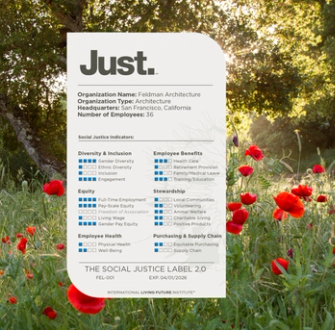
Just 3.0 Certified
Feldman Architecture is proud to announce the successful renewal of our Just Label, achieving a Just 3.0 certification and reaffirming our commitment to transparency, equity, and accountability.
Administered by the International Living Future Institute (ILFI), the Just Label functions much like a nutrition label for organizations, offering a clear framework for evaluating and improving social justice and equity practices across operations and policies. As a voluntary disclosure tool, the Just Label asks participating firms to report on a range of indicators - from employee demographics and benefits to charitable giving and volunteering - and provides a benchmarking system for measuring accountability across four levels of performance.
Our Just 3.0 Dashboard provides information on each of our 21 performance indicators, along with the company policies that address each indicator. The Just Label offers a thoughtful scaffolding for navigating difficult questions and examining the many dimensions of a value-based practice. Rather than having to build an internal audit from scratch, the benchmarking system helps us identify where we are excelling, where we have room to grow, and where we can direct our resources most meaningfully. Just has also helped us establish one-, three-, and five-year goals, giving us a way to track our progress and share intentionally and transparently.
Additionally, Feldman Architecture recently developed a set of Corporate Social Responsibility (CSR) guidelines to more clearly articulate the values that guide our committee, the pro bono projects we engage with, and the volunteer and mentorship opportunities we champion. These guidelines are rooted in three core commitments: community engagement, social equity, and environmental stewardship. It reads as follows:
We strive to better the built environment for underserved communities, dismantle economic and social barriers within our profession, and partner with organizations working to confront inequity and discrimination. We also believe that leading by example - championing environmental stewardship and creating regenerative, responsible architecture - is another way we can serve our communities and future generations.
These guidelines reflect the belief that our responsibility as architects extends beyond the projects we design. Our values inform not only the work we produce, but also how we engage with our employees, neighbors, community, and the natural world.
Just 3.0: A Second Look
To complete this latest round of reporting, Feldman’s CSR committee spent the last year reviewing and discussing our studio’s operations and policies. We reflected on where we wanted to focus our efforts, where our existing policies could be strengthened, and how we could best allocate resources.
Just 3.0 differed from 2.0 in its requirements - we found that ILFI significantly improved and streamlined the process, while also requiring significantly more documentation and providing detailed feedback. It was challenging to earn a 3.0 label, but having been through the process gave us a stronger understanding of the framework. Our CSR committee dove deeper into individual indicators, solidified policies that were already in place, and drafted new ones when needed.
What We’re Proud Of
Just 3.0 felt less like a checklist and more like an ongoing conversation. One of the most valuable outcomes of the Just process has been the conversations it’s fostered within our studio and with our leadership team. Having a shared framework, clear goals, and specific guidelines makes it easier to raise complex issues and move from discussion toward action. Our studio also hosted two open office conversations about our new CSR guidelines, discussing internally the role we want to play politically and socially in our community and how we want to represent ourselves as a firm – allowing a chance to solicit feedback from all staff.
The CSR Committee conducted an internal survey, which gave us encouraging feedback - we were pleased to see that most of our staff feel included and engaged, and we scored highly for our robust internal review systems, our clear roles and responsibilities, 360 feedback & review process, and clear, transparent promotion and salary guidelines.
Notably, as Feldman has expanded beyond California with the opening of our Utah office, the Just process encouraged us to think carefully about how our benefits and policies can support employees across locations. We wanted to ensure that employees in Utah can access a comparable level of support and benefits to those available to our California employees, while also recognizing the differences between the two states, which proved complex.
We were also proud of our results around pay equity. Our overall pay scale equity score was higher than we had originally anticipated, and we received a particularly strong score for gender pay equity. As an office that is more than 50% women, maintaining equitable compensation practices remains a priority.
At the same time, the process helped us identify areas where we still have room to improve. While we were proud of our gender diversity, our demographic survey showed that our ethnic diversity does not yet reflect the demographics of our county. Recognizing that gap is an important first step toward thinking more intentionally about recruitment, retention, and belonging.
Looking Ahead
Just 3.0 introduced us to several new indicators that prompted particularly useful conversations around Procurement, Recruitment, Accessibility, Racial Equity, and Pay Scale Equity.
These indicators gave us an opportunity to look closely at how we interview, onboard, support, and retain employees; how we source materials and products for our office; and how we can make our workplace more accessible to staff, clients, consultants, and visitors.
We dove especially deep into our procurement practices. Over the next two years, we plan to improve the quality and transparency of the products and materials we source for our office, building on the same values of responsible stewardship that guide our architectural work.
Ultimately, the Just Label process has spurred worthwhile conversation throughout our studio and has encouraged us to think critically about topics both large and small. We’re happy to share more about our process, and we’d love to hear from others working through similar questions. Please reach out if you’d like to learn more about our Just 3.0 experience or discuss any of our policies—we’d love to chat.